Mirror of the Free
More excerpts from Mirror of the Free

Authors of
books on the Tarot cards commonly assert that their true origin is unknown. One
sometimes gets the impression, however, that their attitude to the mystery it
presents is ambivalent: knowledge means not only less excuse to speculate but,
also, more responsibility. They write as if they want to know; or as if they
want the reader to think they want to; or as if they acknowledge, almost
reluctantly, that they really ought to make an earnest effort to find out: but,
when it comes down to it, might, for some reason, prefer not to...
Perhaps more
generally, and less excitingly, there is the threat of something even more
difficult to deal with: a sense of anticlimax. Instead of enjoying the mystery,
one has to work at understanding something.
It is true that if
you read this book you may find it difficult to continue to justify the uses to
which you are accustomed to putting the Tarot.
On the other hand,
you may decide that there is a great deal more to the Tarot than you ever
suspected; and, having become aware of certain facts, that those facts conflict
with your beliefs; and that, if you are to be honest, you have to shed some of
them.
If what you are
already doing with the cards, as they say, 'works for you', you may even find
that the information offered here constitutes an opportunity to come to a deeper
understanding of what it is you have really been doing all along...
Looking at
photographs of impressions made by Mesopotamian cylinder seals can be almost
the same as looking at an old photograph - a very old photograph.
Four or five
thousand years old, to be precise.
It is not really
the photographs that are old, of course: it is what has been photographed.
Because they are
physically relatively shallow impressions, and have to be highlighted to be
clearly discerned, they have an eeriness about them, attributable though this
may be to our conditioning through occupying the place we do in the history of
visual media. (The present book uses charcoal pencil drawings closely based on
the originals.)
Figure 2 shows a
Mesopotamian deity that has not been identified with certainty.
How do we know it
is a god? By the horns. Its head-gear, if you look closely, is curled up at
each side. In the times and at the place of which we speak, one of the ways
that gods and goddesses were recognized was by their horns.
Isn't that the
wrong way round, though? Isn't it the Devil who has horns?
If it is a god -
and thus corresponds, presumably, to something good - why does it have horns?
Or is it just proof
that all those old pagans were wicked anyway, worshipping what we now know to
have been evil?
On a more basic
cultural and, even, psychological level, the issue of 'the Devil' being, in
popular imagination, a creature with horns relates critically to the question
of the difference between appearance and reality.
The same theme
features in a brief passage in Ihya 'Alam ad Din (Revival of
Religious Knowledge) by the exceedingly influential eleventh (CE) century
Muslim thinker and Sufi Al Ghazali.
In discussing
knowledge of 'the world' and contrasting it with that of spiritual things, he
wrote: 'He who is experienced in the religious sciences is inexperienced in
worldly learning. For this reason, the Prophet said: "Most of the inmates
of Paradise are indifferent": in other words, they are inattentive to
worldly matters.'
It is the next
line, however, that is arresting in the context of considering understanding of
'devils' or 'the Devil', mainly because the way in which it is phrased would
seem to suggest that it might allude to the reported ability of Sufi masters to
somehow experience the immediate, living presence of other Sufis of the past
and future, even the distant past and future, and to communicate with them:
Ghazali quotes another historically prominent Sufi named Hasan al Basri ('of
Basra'), thus: '"We have seen such people whom you would think, if you had
seen them, diabolical... If they had seen you, however, they would call you devils."'
Basra was, at the
time of Hasan - and is still today - in what is now called Iraq. Indeed, it is
only a few miles from the modern city Babylon.
'They would
call you devils...'
Looking again at
the image of what has universally been interpreted as a tower struck by
lightning, what may strike us is the fact that the object - or phenomenon, if
you insist on seeing it as lightning - that seems to be causing the destruction
resembles nothing so much as a gigantic feather.
The winged gate or
door (Figure 19) is one of the motifs that occur over and over again in
Mesopotamian seals for which no one seems yet to have come up with a satisfying
explanation.

It thus seems at
least possible that the eight sefiroth of the original Kabbalah of the Ikhwan
as Safa and the Sufis consisted of the seven lower sefiroth of the
Kabbalah we know, plus the three upper sefiroth combined into one; if
so, it would confirm Blavatsky's assertion that the division of the top sefirah
into three is a 'blind'. Moreover, the description of the first three sefiroth
as 'hidden potencies' that 'do not act in the visible sphere' as do the other
seven obviously closely parallels the relationship, and difference, between the
law of three and the law of seven as Gurdjieff taught them.
In Figure 11 we see
the king, the one in the middle, with his two escorts, who are divinities in
their own right. The round object on the table the leg of which the individual
in the front is grasping is a 'sun-disk', an emblem of the god Shamash, the
great god to whom the king is being presented. About the odd bearded fellows in
the upper right, even what significance it may be possible to gather in the
context of the stele image cannot be considered here, because what is shown
here is only that part of the scene that is likely to have been the origin of
the image on the card The Lovers. It requires no great effort of imagination to
see how the figures aloft who seem to be executing some procedure with some
kind of ropes extending down to the sun-disk have become the arrow-shooting
angel, and the sun-disk the angel's nimbus.
Over the centuries
of their existence up to the time of the writing of the books of the Bible -
as, of course, in the centuries since - the Jewish people, whether through
captivity or by other means, came into contact with a wide variety of foreign
cultures and languages, and their language, Hebrew, was inevitably much changed
by those contacts. Arabic, on the other hand, was, until the time of the
expansion of Islam, the language of a relatively isolated people. One
consequence of these unarguable historical facts is that of existing languages,
Arabic is the closest to Protosemitic. If knowledge or methods of encoding and
accessing it, or both, were woven into Protosemitic, and they are to be sought
in any currently used language, Arabic is the obvious choice.
If, moreover, we
take the methods - the ones of which we may have an inkling, at any rate - used
to embed knowledge in one place (such as Arabic) and try them out in another
(such as ancient Hebrew writings), especially when the two are known to have a
common ancestor, and the results appear meaningful, it is reasonable to
conclude that the same methods were used to embed knowledge in that other
place.
The philosophical
principle that dates from the European Middle Ages and is referred to as
Occam's Razor states that if there is a simple explanation for something, you
should not seek a more complicated one.
The obvious defect
of this principle is that one's very notion of what constitutes simplicity is
itself almost certainly heavily culturally conditioned: which is to say it rests
on a foundation of relative ignorance that is felt, on the contrary, to be a
foundation of relative knowledge.
Another way of
putting it might be to say that Occam's Razor is fine for shaving, but try to
use it to do something requiring a finer instrument, such as brain surgery, and
you will discover its limitations.
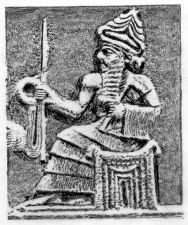
It is worth looking
again at the image of Shamash sitting receiving Nabuplaiddin, and considering
in juxtaposition to it another passage in Meetings With Remarkable Men.
In the passage in
question, Gurdjieff is describing what was ostensibly an attempt he made to
relieve his poverty by setting himself up as a shoe shiner on a public street.
Not having much luck at first, he decided he needed to innovate, and so
obtained an armchair of some special kind, and put one of Edison's phonographs
underneath it, where it would not be seen by casual observers. To this he
connected, he says, a flexible tube with, on the other end, an apparatus that
the customer, while resting comfortably in the armchair, could put to his ears
even as Gurdjieff surreptitiously started up the record player for them. He
even names the Marseillaise as one of the pieces of music they would indulge in
(others being operatic works) while he shined their shoes. Further, he says, he
affixed to one of the arms of the chair a tray to bear liquid refreshments and
magazines. His advanced ideas about customer service paid off well, he notes.
A third passage may
be reflected upon in the light of the two odd bearded figures, who only seem to
exist from the waist up, leaning out from the front of the covering of
Shamash's shrine in Figure 29 or 31.
He says that, one
day, as he was walking on the Kurfurstendamm (in Berlin) toward the Zoological
Gardens, he spied a man, who had lost both of his legs, on a little
hand-operated wagon and turning the crank on an 'antediluvian' musical box.
Somewhat further on, he again mentions the character, having related a story
about his life as it had been before he came to his current predicament; again
he describes him as without legs, operating the music box in the manner
described, and accepting German coins of small denomination from passersby.
In his initial
general behaviour, Gilgamesh obviously represents the commanding self or,
possibly, even the nafs al haywaniya, the 'animal self', to which
regular commanding-self people may sink if they are not careful. He meets and
does battle with his 'twin' - Enkidu, the wild man - which is to say,
unconditioned or less-conditioned reality, a spiritual reality that is also his
own real self or, possibly, a teaching pertaining to it. Enkidu is rendered
more presentable after his rendezvous with and seduction by Ishtar's agent,
which represents the capturing and relative neutralizing of that reality by the
lower, conditioned world. (Another ancient story with the same theme is the
Biblical story of Esau and Jacob, which we will look at soon.) Enkidu's
struggle with Gilgamesh may thus also correspond with the manifestation of the
accusing self, and their subsequent harmonization with the inspired self, or nafs
al malhama: Gilgamesh and Enkidu together slay Humbaba, the beast in the
forest; as it happens, another spelling of malhama means 'bloody combat,
slaughter'.
Shibli must have
seemed like one kind of fool when he, an intelligent and capable man, followed
the instructions of Junayd and sold sulphur, begged, and went from door to door
looking for people he might have offended during his career as a civil servant
in order to apologize to them. He must have seemed like another kind of fool
when he first put sugar in the mouths of those who repeated the name of God;
and then, as his 'state' increased, offered gold to those who would repeat it
for him; and finally, when anyone repeated it, came after them with a sword
because, he said, he had realized that they were only doing so out of
mechanical habit.
The gradations of
being in this scheme of the Ikhwan do not represent aspects of divinity,
but stages of manifestation. Nor do they, as given, have intricate and specific
interconnections as seen in the sefirothic ‘tree’. The intermittent
inclusion in the midst of the latter of Da’ath, ‘knowledge’, however, and
the interconnections of the points of the circumference of the enneagram, the
inner triangle of which is supposed to represent the vital status of the thing
or process represented, does suggest that the formulators of the sefirothic
Kabbalah were trying to produce something of their own by combining elements of
the teaching of the Ikhwan and the enneagram of the Sarmoun, and other
Sufi doctrines as well.

Wasu'a
(after 'Esau', of course), on the other hand, corresponds to meanings of
'spacious, vast, extensive', 'contain, comprehend, encompass, include', and 'be
generous, liberal, open-handed': suggestive of the spatial, 'holistic' (to use
an over-used word), and selfless aspect of the mind. Waswas is
'temptation, delusion, fixed idea', and also 'anxiety, concern, melancholy'. Iswa
means 'example, model, pattern'.
Isaac in his
fatally weakened condition represents the same reality as Esau rendered
delicate by extreme hunger, the same hunger that Isaac now expresses when he
states his desire for some of Esau's strongly flavoured wild game (the
vividness of less-conditioned reality). The difference is this: Esau, after he
had partaken of Jacob's bowl of stew, recovered; Isaac is not going to recover.
Sufis say that spiritual states are temporary, but stages are permanent.
The fact is,
Mesopotamian cylinder seals have more people pouring things in them than the
U.S. Air Force has explanations for Roswell.
The days and nights
as well of Mesopotamian priests were anything but badly planned, being filled
with precisely timed prayers, liturgies and sacrifices, and with new moons and
the ends of months marked by festivals. Each deity had its own priesthood, from
the highest offices of (the Sumerian) sanga and en all the way
down to the sacred temple prostitutes that scholars since the advent of Latin
have politely referred to as 'hierodules', very large numbers of whom, along
with eunuchs, were necessary for the rites of Inanna/Ishtar to be properly
performed. Speculation is still the best we can do when it comes to determining
the precise functions of the various categories of priests, although their
Sumerian and Akkadian names are known; one kind, for instance, seems likely to
have been concerned with literary and musical forms of worship, and another
with the flow not of sounds, but of celebratory inebriants and ablutions.
The name 'Iblis',
again, means 'the wicked one', or 'the hopeless'. His other name in Arabic, Shaitan,
means 'one who opposes'.
Satan particularly
disliked that he, a creature made of fire, was expected to humble himself
before man, who was made of mere clay. 'So the angels prostrated themselves,
all of them together: not so Iblis: he refused to be among those who prostrated
themselves. God said: "O Iblis! What is your reason for not being among
those who prostrated themselves?" Iblis said: "I am not one to
prostrate myself to man, whom Thou didst create from sounding clay, from mud
moulded into shape." God said: "Then get thee out from here; for thou
art rejected, accursed. And the curse shall be on thee till the Day of
Judgment."' (Koran, Sura 15, verses 30 to 35.)
Gurdjieff's
explanation as conveyed by Ouspensky is confusing inasmuch as he says that the
broken-away pieces of consciousness that unite and are, in effect, evil in the
sense that they oppose the (new) evolutionary manifestation are themselves from
the evolutionary process (presumably an earlier, failed one), but that they do
so at certain points in the involutionary process. The 'involutionary process'
and 'evolutionary process' sound more than a little like the Sufis' 'arc of
descent' and 'arc of ascent'. Apart from the context of individual souls,
examples of involutionary processes would, one thinks, be all forms of higher
teaching that become coarsened and distorted through progressively greater
degrees of mixing with the lower levels of reality: like Esau eating his stew,
or Ishtar in the underworld, or like a great religion twisted into a killing
machine, or like Sufi teachings in a pack of cartoonish cards. The evolutionary
process, however, would seem to be something that takes place partly through
engaging with those remnants, if only to the purpose of developing the
discernment to understand that that is what they are, and then going on to seek
out fresher and purer impulses.
The idea of it
happening at certain points in the involutionary process, then, can only mean
when a certain quota of transcendent content has been lost; when a certain
corner has been turned, in the sense of no longer merely deviating from the
original direction, but becoming opposed to it. It resonates, 'like calling to
like', with the errant consciousness at a vulnerable stage in its evolutionary
climb, and turns it aside.
Zohra, Venus, is
Ishtar. In the myth of her descent into the underworld, she escapes by
arranging to have Tammuz substitute for her, which it turns out may be a way of
saying that when people get through with distorting a teaching about higher
reality, all they are left with is their own tendency to turn something alive
and uncontrollable into something as docile as a sheep. One way of reading the
story may be to see the two principal characters' 'substituting' for her as having
the same significance. One of the meanings of nabi is 'deputy', who is a
substitute for the higher authority. People come to the Tarot cards wanting to
learn a kind of magic...
None of this is to
discount the importance of the fact that, for instance, there is a basic
practical - if you like, psychological - relationship between 'secrets' and
'power'. Arabic for 'hair' is sha'r. In fact, if meanings of words that
sound like sirr and sar and sha'r are considered
altogether, one of the things they can be assembled into is the story of Samson
in the Biblical Book of Judges.
'"Once so
strong and mighty,"' the Contemporary English Version has him
saying, in the 'riddle' he composed after he found the lion he had slain
earlier with his bare hands had bees living in the carcass, and he had sampled
their honey, '"- now so sweet and tasty!"'
'When the seeker of
truth,' Attar records Abu al Hasan Khirqani as saying, 'has cheerfully tasted
poison nine times, on the tenth time he tastes sugar... To me it is as if there
is something I do not know but that is in my stomach and that feeds me. It is
as sweet as honey and as fragrant as musk. The world does not know in what way
I am fed.'
The Tablet of
Destiny or, to use the Sumerian word for it, the me ('meh' or 'muh'),
was a sort of divine template. They are sometimes referred to (whether by the
ancients or by the translators) in the plural, the Tablets of Destiny. The me
were, according to some, the property of Enki/Ea (even though Zu stole them
from Enlil), and occupied a position of overwhelming importance in the religion
of the Sumerians and, hence, for the many people who took over their land and
religion. They were the decrees of heaven, written before our world came into being,
and formed the basis of all insititutions and, even, every aspect of society,
religion and civilization; from another point of view, they were discussed as
including actual physical objects as well as abstractions, from musical
instruments and artisanal tools to truth and lies, sex, various kinds of
priest, victory and royal paraphernalia.
Let us consider
this startlingly un-primitive conception in light of the ideas that we
discussed earlier about levels of reality emanating from a sublime source.
Looking down, as it were, from God's point of view - and as blasphemous as that
might sound, it is only an exercise to try to follow what the great teachers
have said about how it really is - the First Intelligence was created; the
Universal Soul was produced out of that; and the Intelligence then transmitted
to the Soul - the Pen wrote on the Tablet - everything that was to be; and the
World Soul made it, and continues to make it, happen. At some point, as Ibn al
'Arabi said in so many words, this means everything we know ...
'Arsh means
'throne', but a closely similar word, arsh, in Arabic means 'creatures',
in the sense of 'all creatures'. In its meaning it corresponds with the sefirah
Malkuth, 'kingdom', even though in the Ikhwan's formulation it was
meant to comprise 'minerals, plants, and animals', but not humans.
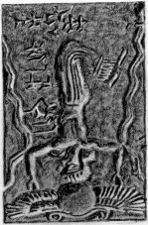
The opinion of
historians is that the individual shown in Figure 53 - the original is right
side up - is the priest spoken of in the seal's accompanying inscription. Adad,
again, is another name for Enlil and is, supposedly, represented by the winged
disc to which the priest is raising his arms. His mid-air position may indicate
that he is performing some act of ritual worship, or that he is dancing ecstatically,
as did the dervishes of the god Baal on Mount Carmel who are mentioned in the
eighteenth chapter of the first book of Kings in the Old Testament.
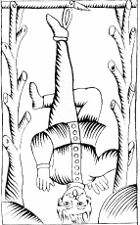
The reason for
showing him upside-down here should be obvious. Someone else, a few hundred years
ago, also saw him that way.
The origin of the
name, 'The Hanged Man', may be not that hard to discern: the inclusion of the
word 'man' could be what gives it away. We have already seen the importance of
the Sufi teaching concerning what they call al insan al kamil, the
'perfect' or 'complete man'. Insan is 'man', kamil is 'complete'.
Another word for 'entire, total, universal' is kulliya(t). Arabic for
'hanged' is 'alaq. Someone may very well have misread insan al
kulliya(t) as insan al 'alaq.
That leaves the
question: what gave them the idea of a 'hanged man' in the first place?
Where the Moon card
showed a situation, a condition, in which there is no 'self' to be seen and,
yet, there is a suggestion of something that was, at some point, constructed,
although it now may be in disrepair - the lunatic world, in which the fateful
moon syphons off the energies that could, with effort, knowledge and luck, be
raised to the spiritual level of the Sun; yet for which, paradoxically, there
is still (in a word) hope - while that is the case with The Moon, the scene on
The Devil may show the end result of persisting under that influence, of
failing to escape it, where two beings regard each other with what may be
desire, or loathing, or horror: but is unlikely to be indifference, because the
fact that they are bound, held in stasis, would be meaningless if they had no
will to be restrained and to make it worthy to be called Hell; if it is
anything like attraction they feel, they are so similar-seeming as to make that
something of a joke; and, if loathing or horror, the same applies, although for
the opposite reason. They cannot even be said to have the satisfaction of
being, fully, whatever it is they now are, as is demonstrated by their stunted
state relative to the 'real' Devil who, obviously, rules over them, and whom
they - as a further dimension, almost a luxury, of unfulfilment - are prevented
from seeing and knowing. The two may be and, indeed, probably are - in the
perfect expression of the nature of Hell - the same person: and that person's
being portrayed as two small, imprisoned devils may be the ultimate
representation of what it means to have a self, to be a self, to be condemned
to be that self, and never have the possibility of being anything but that
self, yet not to know that self, and to know that you do not know yourself, and
now never will.
Same people;
different card. Same sun. It is even apparent that the horizontal lines of the
support for the sun-disk have transmogrified into the brick wall behind the two
friends. One could say that it is not unlike watching Law & Order
and noticing that the actor who is playing a blackmailing doctor in the current
episode is the one who played an accountant who was an important witness a few
weeks ago; but, there it is.
That the importance
of the duality of consciousness that in our time has found an anatomical
correlative in the brain hemispheres was something recognized by the ancients
is shown by the fact that the Jacob and Esau story is far from being the only
part of the Jewish scriptures to deal with it.
While it may have
been Herakleitos who said, 'Character is destiny', and Nietzsche who said, 'I
am a destiny', only Butt-head, or someone very much like him, can, with full
accuracy, say, 'I am a character'; and in the last analysis, of the three, he
is by far the most influential.
mirrorofthefree@topmail.ca